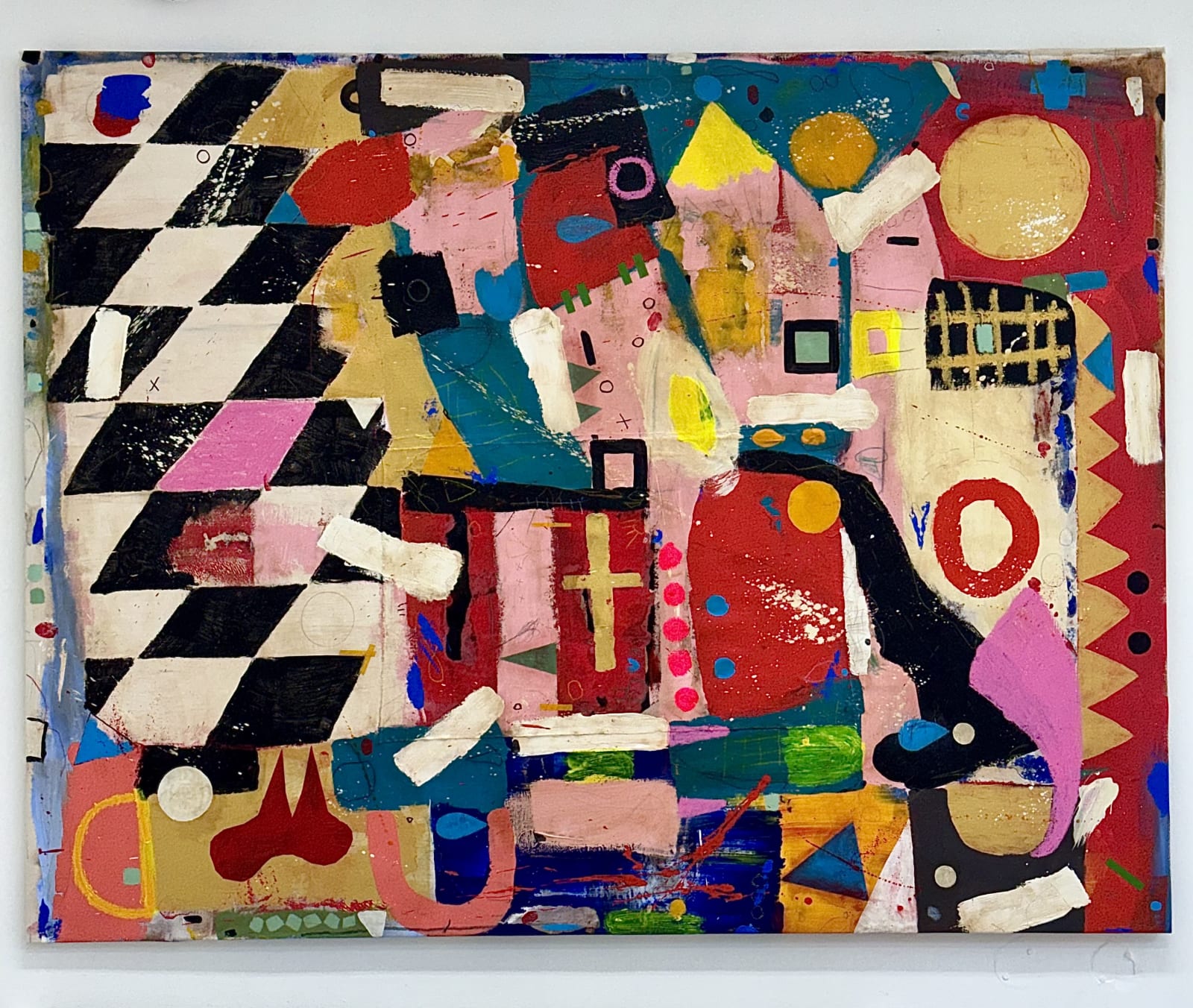
Love Letters (2017–present)
An ongoing series, 86 works so far. I made these works as a way of talking to another person. Each one carries a coded message.
Medium: Photography, collage, drawing, digital drawing, oil, acrylic, ink, watercolour
Windows (2025)
Made at the end of my first year at NCAD and shown at the first-year exhibition as an installation: Allaprima Series I–III with the digital print Move On. It started as a photo archive of frames, windows and screens, which I pushed through digital edits, quick pastel studies and finally acrylic painting.
Medium: Digital print on archival paper, acrylic on canvas
Mobile Artworks (2014–2015)
Images and short animations made entirely on an Android phone. Smartphones were still new, and I was amazed how much such a small device could do. I tested the apps, often starting from a single word. It was a way of learning a new medium and of giving shape to what I was turning over in my head.
Medium: Digital
Spatial Interventions (2014)
Photographs of real places with glowing wireframe forms added to them, all shot, drawn and edited on a phone. I was fascinated by the idea of something outside our everyday world, a dimension we can't see. The forms sit in the landscape like traces of something not quite human passing through.
Medium: Digital
Mobile Street Photography (2015–2019)
Photographs of Dublin taken on a phone during walks and everyday errands. I had worked with film and full-frame cameras, but the old rule holds: the best camera is the one you have with you.
Medium: Photography
#12x2 (2014)
When mobile photography rarely entered Polish institutions, #12x2 examined what happens to an image born in social feeds when entering the white cube. The title pairs the hashtag, native to network culture, with the form of twelve diptychs (12×2). Each diptych comprises two prints from photographs made on an early smartphone and processed exclusively in Instagram as it existed at the time.
Medium: Photography prints
Some Kind of Mood (2011)
October 2011, Poland.
Medium: Photography
Winter (2013)
Winter 2013, Poland.
Medium: Photography
Marcin Jachim (b. 1979) is a Polish painter and photographer based in Dublin since 2015, currently studying BA Fine Art Painting at NCAD. He trained as a photo technician in Katowice, graduating in 2010.
In 2011 he co-founded Fotografia Komórkowa, a Facebook community of several thousand members sharing smartphone photography. His 2014 solo exhibition #12x2 at Galeria Pusta C.D. was among the first institutional presentations of mobile photography in Poland.
- Solo exhibitions
- 2014 – #12x2, Galeria Pusta C.D., Jaworzno, Poland
- 2010 – Solo Exhibition, Municipal Public Library, Jaworzno, Poland
- Group exhibitions
- 2026 – No Fit State, NCAD Year 2 Painting, IMMA Studios, Dublin, Ireland
- 2025 – Windows, NCAD First-Year Exhibition, Dublin, Ireland
- 2016 – Face to Face; 100 Years of Portrait Painting, Art Uncovered Fine Art, Dún Laoghaire, Ireland
- 2014 – Street Photography / Nieobiektywni collective, Municipal Public Library, Jaworzno, Poland
- Curated selections
- 2014 – Création Photographique Mobile, Arts and Mobiles symposium, National Institute of Art History, Paris, France
- Awards
- 2015 – 2nd prize (Street Photo category), MOBILNI national photography competition, Poland
- Collective work
- 2011 – Co-founder of Fotografia Komórkowa, an independent mobile photography group
- Education
- 2024–2027 (expected) – BA (Hons) Fine Art Painting, NCAD, Dublin
- 2010 – Post-secondary diploma in photography (photo technician), Katowice, Poland


